
Judge Elena Berthotyová spoke at the conference on Current Issues in Refugee and Aliens Law
On 14 and 15 November 2024, the President of the Panel of the Supreme Administrative Court of the Slovak Republic, Elena Berthotyová, participated in the scientific conference “Current Issues of Refugee and Alien Law” organised by the Ombudsman of the Czech Republic in the premises of the Otakar Motejl Auditorium of the Supreme Administrative Court.
Each of the speakers present – representatives of the judicial and academic spheres, NGOs, the Ministry of the Interior of the Czech Republic and the Office of the Ombudsman – had a different role to play in the complicated tangle of refugee and alien law. What they had in common, however, was that they wanted to find solutions to complex problem.
Judge Berthotyová spoke on the first day of the conference together with Natasha Kovář Chmelíčková (from the Ministry of the Interior of the Czech Republic, Department of Asylum and Migration Policy), who reported on the biggest challenges of the “Pact on Migration and Asylum”, and Judge Jitka Zavřelová, who reported on the current case law of the Extended Panel of the Supreme Administrative Court of the Czech Republic in the field of asylum law.
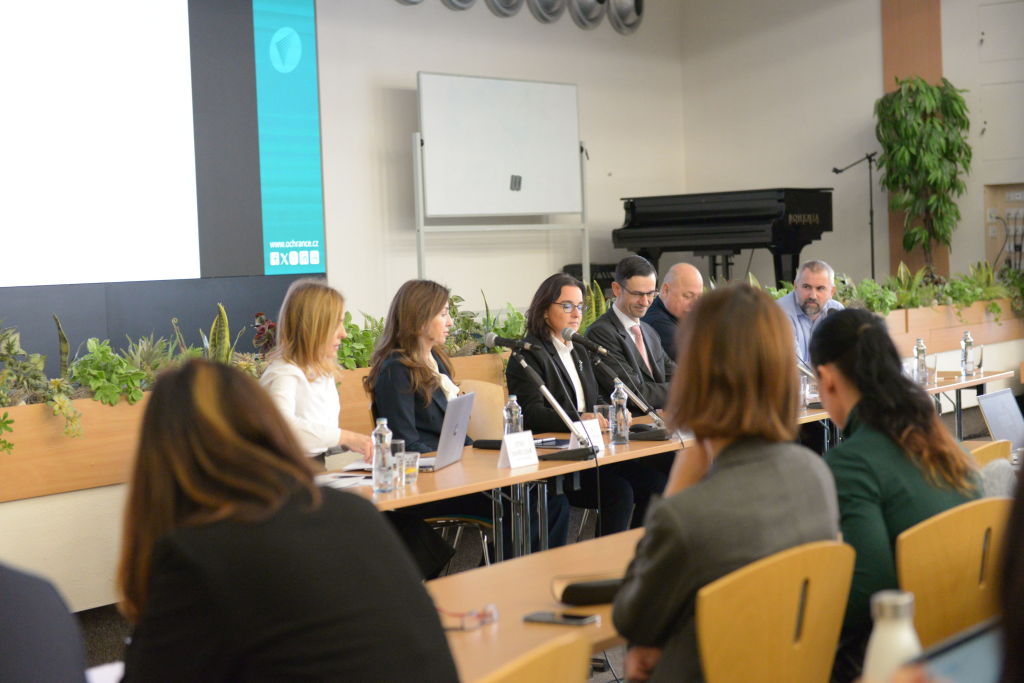
Judge Elena Berthotyová at the scientific conference Current Issues of Refugee and Alien Law. Photo © Supreme Administrative Court of the Slovak Republic.
In her lecture “Refugee waves and refugees in the case law of the Supreme Administrative Court of the Slovak Republic” Elena Berthotyová discussed not only the refugee waves, the impact of the latter on the decision-making activity of the Supreme Administrative Court in asylum cases, but above all she acquainted the participants of the conference with the most important decisions published in the Collection of Opinions and Decisions of the Supreme Administrative Court of the Slovak Republic. In particular, they dealt with legal issues related to membership of a social group under the Asylum Act, information on the country of origin, prospectivity of asylum decision-making, the audiatur et altera pars principle (let the other party be heard as well), and the principle of the best interests of the child in asylum proceedings.
At the end of the lecture, she drew attention to the fact that judges deciding on refugees are placed in the position of solving a dilemma. The dilemmas of the asylum judge (in Prof. Holländer’s words) oscillate between the Skylla and Charybdis of a strict, cold law and compassion for the tragic fate of the refugee. However much asylum adjudication must be linked to a clear legal grasp of its purposes and the integrative potential of the country, ultimately the judge is left alone faced with the necessity of making a decision.
She pointed out that the jurisprudence of the Supreme Administrative Court in asylum cases offers a way out of this dilemma, offering a view representing ratio, incorporating the key parameters of asylum decision-making contained in international treaties, EU legal acts, and national law, while appealing to humanity, humanity.
She stressed that the judges of the local court relied on Article 31 of the Vienna Convention on the Law of Treaties, which requires that treaties, such as the Refugee Convention, be interpreted in good faith, in accordance with the ordinary meaning given to the terms of the treaty in their overall context, and also taking into account the object and purpose of the treaty.
In other words, the Refugee Convention has been understood and interpreted in accordance with the ‘generous spirit’ and intentions of the Convention, namely the protection of refugees, and not through a literal or restrictive interpretation, because the chilling images of the victims and destruction that we believed were already a thing of the past on the European continent remind even judges in the service of the Slovak judiciary that peace and freedom are not unshakeable achievements and that anyone can become a refugee should the situation change. They, you and us.