
Conference marking the 75th anniversary of the European Convention on Human Rights recalled the important role of administrative courts in protecting individual rights
On 2 October 2025, the President of the Supreme Administrative Court of the Slovak Republic, Pavol Naď, participated in an international conference entitled “75 Years of the European Convention on Human Rights: The Role of Administrative Court Judges” in Warsaw.
The conference, organised by the Supreme Administrative Court of the Republic of Poland in cooperation with the European Court of Human Rights at the Royal Palace in Warsaw, was opened by the President of the Polish Supreme Administrative Court, Jacek Chlebny, the Deputy President of the Republic of Poland, Zbigniew Bogucki, the President of the European Court of Human Rights, Mattias Guyomar, the First Advocate General of the Court of Justice of the European Union, Maciej Szpunar, the Commissioner for Human Rights, Marcin Wiącek, and the President of the Association of the Councils of State and Supreme Administrative Courts of the European Union, Michail Pikramenos.
In addition to the highest representatives of administrative courts from several European Union countries, the annual event was also attended by judges of the ECHR and judges of the visiting court.
The conference was divided into three thematic blocks. The first was devoted to the topic of the Convention as a tool for judicial review of administrative court judges. The speakers emphasized that the Convention should not be just a symbolic document and that administrative courts should take it into account in their decision-making. It was also stated that administrative courts are responsible for protecting rights in society.
The application of ECHR decisions by national judges was the thematic focus of the second block. The panelists stressed that it is important for judges of national courts to apply the Convention in their work with the awareness that law and laws are an instrument of equality and justice. It was stated that the task of judges of administrative courts should be to identify possible threats to individual rights and freedoms and that human dignity must be the focus of judges. The fact that the protection of individual rights by national courts will be ensured has a direct impact on increasing the trust of citizens in the judiciary of individual countries.
The third block dealt with the scope and limits of the degree of application of discretion by judges of administrative courts. It was stated in this panel that the degree and scope of discretion is not uniform and depends both on the subject of the decision and on the state in which the relevant case is decided.
In the final evaluation of the conference, the participants were particularly drawn to the fact that the European Convention on Human Rights is still alive. It is necessary that the dialogue between national judges and judges of the ECHR be equally alive, because they all have one goal in mind, which is the protection of individual rights from abuse of power by public administration bodies.
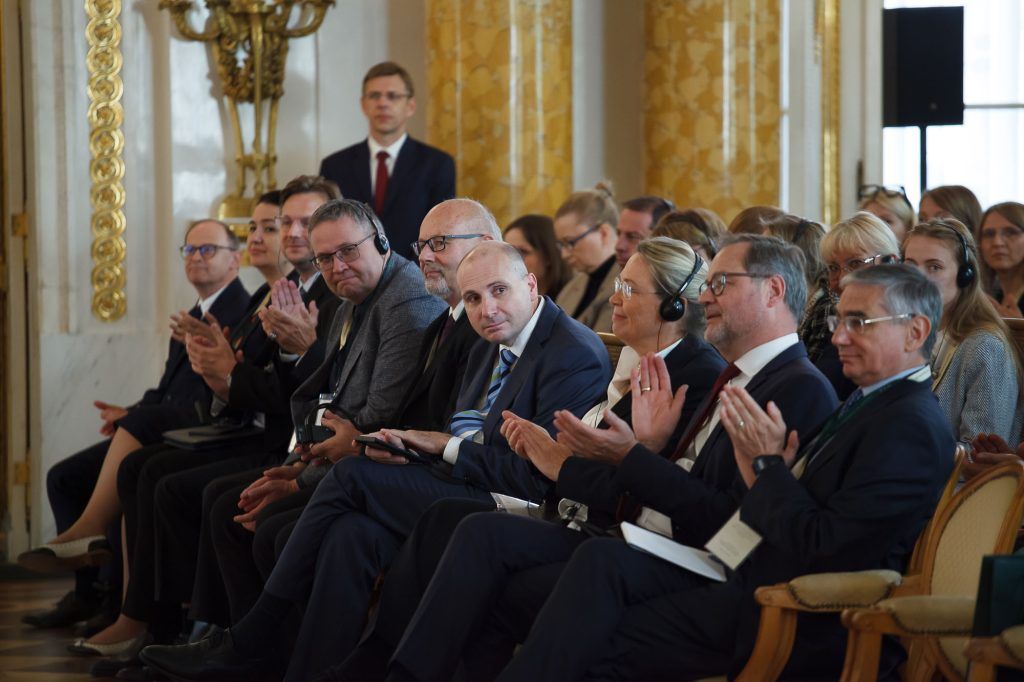
Pavol Naď, President of the Supreme Administrative Court at the conference “75 Years of the European Convention on Human Rights: The Role of Administrative Court Judges”. Photo © Wojciech Zagórski.
“The ceremonial event organized by the Polish Supreme Administrative Court on the occasion of the signing of the Convention also had a strong practical significance for most participants. As follows directly from the content of the Preamble to the Convention, the High Contracting Parties have the primary responsibility for ensuring the rights and freedoms defined in this Convention and its protocols. In this regard, they have a margin of appreciation, which is subject to the supervisory jurisdiction of the ECHR. Cooperation and convergence of legal views on specific issues arising from the Convention between the ECHR and the courts of the participating parties is therefore of profound value. The conference in Warsaw undoubtedly fulfilled, taking into account its content, the expectations of its participants,” stated Pavol Naď, President of the Supreme Administrative Court, after the event.