
Key Milestones from the Five Years of the Supreme Administrative Court of the Slovak Republic
The Supreme Administrative Court is the supreme judicial body in matters of administrative justice, ensuring the uniformity and legality of decision-making in the administrative justice system. It was established with effect from January 1, 2021, by Constitutional Act No. 422/2020 Coll., amending the Constitution of the Slovak Republic, as amended, and began its activities on August 1, 2021.
The Supreme Administrative Court is founded on three constitutional pillars that firmly anchor it within the country’s judicial system. The three fundamental powers of the Supreme Administrative Court, as set out in the Constitution, are the protection of individual rights in cassation proceedings, disciplinary matters, and electoral and political matters. In terms of scope, cassation proceedings constitute by far the largest part of the Supreme Administrative Court’s adjudicative activity. Financial matters—primarily tax cases—have long dominated this area, followed in scope by social matters, general administrative litigation, administrative penalties, and international protection.
In the five years since its establishment, the Supreme Administrative Court has become a well-functioning institution serving the rule of law. Independent and highly professional decision-making is based on the work of the judges, supported by the infrastructure provided by the Chancellery of the Supreme Administrative Court, which operates with well-defined processes. The Supreme Administrative Court currently has 25 judges out of a total capacity of 30. As of February 1, 2026, they serve on 8 Cassation Panels, 4 Disciplinary Panels, and 4 Appellate Disciplinary Panels. The judges’ efforts to ensure predictability and consistency in the reasoning of the Supreme Administrative Court’s decisions are also evident in the work of the Grand Panel and the Competence Panel, which consists of four judges from the Supreme Court and four judges from the Supreme Administrative Court. The court publishes the decisions of its panels on its website at www.nssud.sk. This publication also helps to fulfil one of its important functions, namely the unification of case law for lower courts and public administration bodies, so that they have clear answers to specific questions that arise in the exercise of public administration and are repeatedly the subject of proceedings before administrative courts. The regular publication of the Collection of Opinions and Judgements of the Supreme Administrative Court, which includes the most significant plenary decisions, also contributes to the unification of case law. In April 2026, the Supreme Administrative Court launched a new information system to enable more efficient searching for decisions and checking the status of proceedings. It contains more than 7,000 court decisions issued to date and allows users to search not only by full text search but also using other criteria that can be combined with one another.
The Supreme Administrative Court ruled on nearly 8,000 cases across all agendas for the period from August 1, 2021, to December 31, 2025. It succeeded in speeding up the decision-making process to such an extent that 99.8% of the nearly 2,000 cases transferred from the Supreme Court of the Slovak Republic to the Supreme Administrative Court were resolved. The efficient and professional work of judges, assistants, and analysts is reflected in the number of cases resolved each month, which corresponds to the number of cases received by the court each month.
Throughout its existence, the Supreme Administrative Court has also contributed to resolving issues of the constitutionality of legislation. A total of three motions to initiate proceedings under Article 125(1)(a) of the Constitution were filed, and the Constitutional Court granted two of them, ruling that the legislation was unconstitutional. These decisions by the Constitutional Court are of fundamental importance because they directly affect the validity of legislation. If the Constitutional Court rules that a statute or part thereof is inconsistent with the Constitution, those provisions become ineffective.
Since 2021, the Supreme Administrative Court has filed a total of 7 requests for preliminary rulings with the Court of Justice of the European Union; 5 of these have been decided by the CJEU, while 2 were heard by the Grand Chamber of the CJEU and have a significant impact on the interpretation of law throughout the EU.
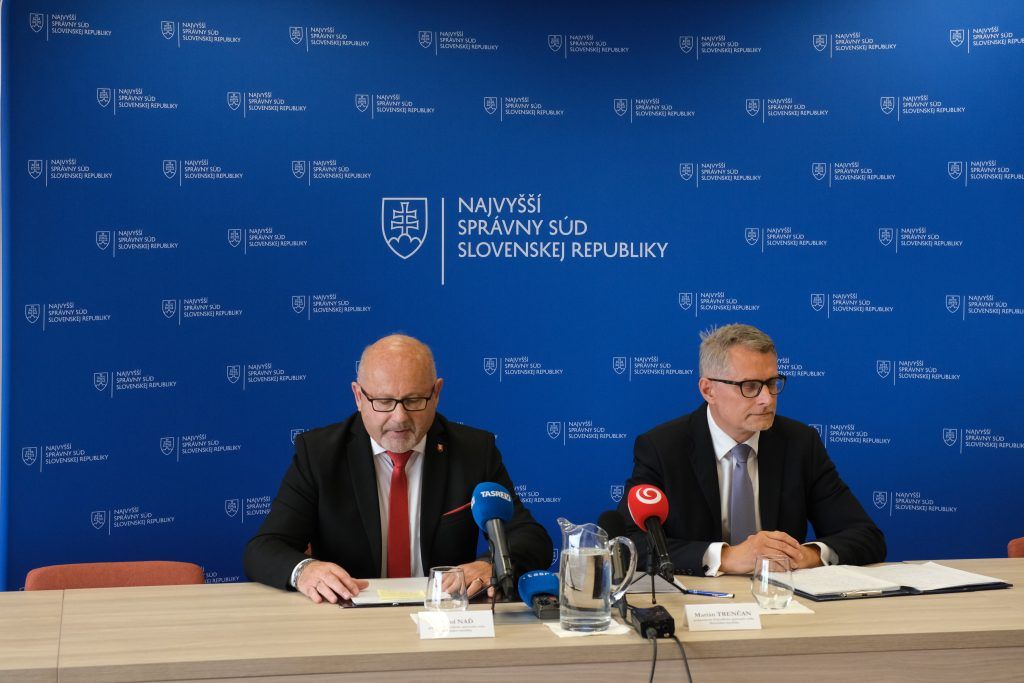
Pavol Naď, President of the Supreme Administrative Court, and Marián Trenčan, Vice-President of the Supreme
Administrative Court. Photo © Supreme Administrative Court of the Slovak Republic
“The Constitution itself enshrines not only the existence of the supreme administrative court within our constitutional system, but also its fundamental types of jurisdictions. First and foremost, this concerns the rule of law and its stability, as well as the predictability of legal solutions in public law relationships, thereby precluding excesses or even arbitrariness when it comes to the subjective rights of natural and legal persons. From the very beginning, I have viewed the Supreme Administrative Court as a guardian of subjective rights. Our effort is to dedicate and direct everything toward justice for every person and the protection of the vulnerable, who are the
recipients of public authority activity,” President Pavol Naď summarized the fundamental functions of the Supreme Administrative Court.
From its very inception, the Supreme Administrative Court has been integrated into European and international structures. It is an active member of international associations of administrative courts, participates in specialized international conferences, and develops bilateral relations with administrative courts abroad. It is a member of ACA-Europe, IASAJ—the International Association of Supreme Administrative Jurisdictions —and is part of the Judicial Network of the EU (JNEU) and the Superior Courts Network (SCN). It works closely with the supreme courts of neighbouring countries.
Since its establishment, the Supreme Administrative Court and its Chancellery have actively established and gradually strengthened relationships with partner institutions in order to ensure a more effective administration of justice. This has resulted in the signing of memoranda with the Constitutional Court and its Chancellery, the Czech Supreme Administrative Court, the Supreme Court and its Chancellery, administrative courts, the Association of Judges of Slovakia, four Slovak law schools, and the Judicial Academy.
“The success of the Supreme Administrative Court over the past five years of its operation is demonstrated in particular by the Constitutional Court’s decisions on constitutional complaints filed against the rulings of our panels in practically all areas of our jurisdiction, which give us reason to believe that we are doing a good job. We also receive positive informal feedback from the public administration, the legal profession, and the tax advisory sector. The plenary session of the Supreme Administrative Court is prepared to continue facing all challenges while producing high quality decisions that enhance the court’s reputation,” stated the court’s Vice-President Marián
Trenčan.