
We have published the presentations from the symposium ‘The Foundations of a New Era of Administrative Justice in Slovakia in Practice’
To provide a summary of information and data on the activities of the Supreme Administrative Court of the Slovak Republic – this aim led to the creation of a separate subpage entitled ‘Conferences and Events’ on the institution’s website, where presentations delivered by judges of this court at the specialist symposium ‘The Foundations of a New Era of Administrative Justice in Slovakia in Practice’, held in May 2026 to mark the 5th anniversary of the court’s establishment, are now also published.
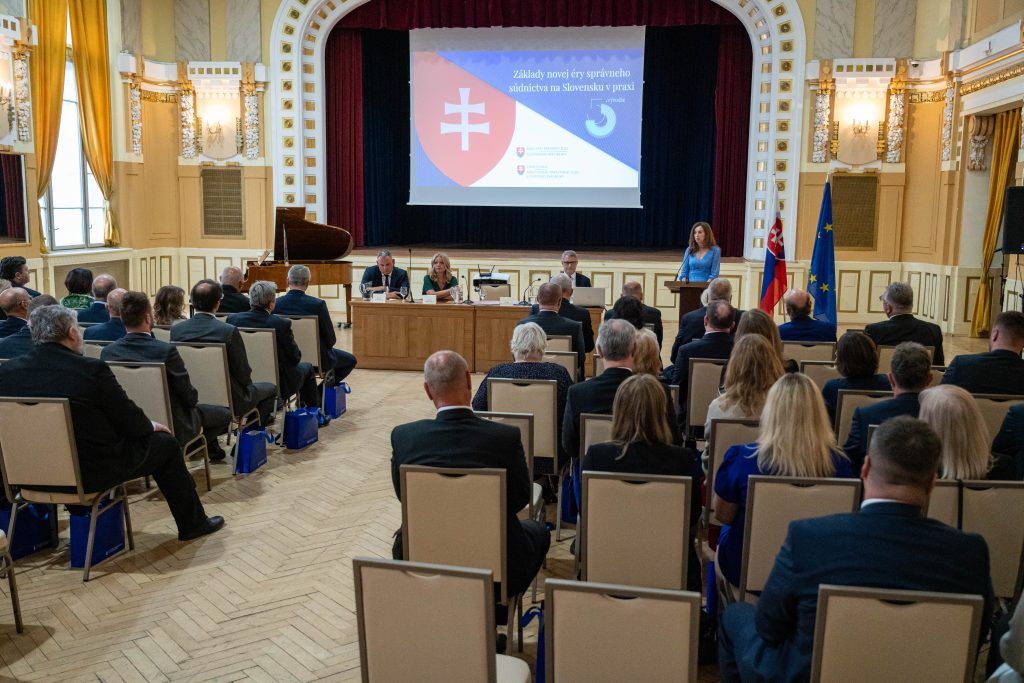
Presentations by judges of the Supreme Administrative Court during the symposium ‘The Foundations of a New Era of Administrative Justice in Slovakia in Practice’. Photo © The Supreme Administrative Court of the Slovak Republic.
Visitors to the website can read the content of the contributions that were presented during the second specialist session of the event, in which judges of the Supreme Administrative Court summarised its case law from 2021 to April 2026, emphasising the need to fulfil its unifying function. The session was opened by the Vice-President of the Court, Marián Trenčan, who outlined the essence of the Supreme Administrative Court’s unifying role and the various tools used to unify the interpretation and application of the law in case law. The unification of case law and the consistent solutions to the same legal and application issues constitute an important function of the Supreme Administrative Court in relation to public administration, the administrative courts, and both the professional and lay public, as it contributes to the predictability of the law, legal certainty and equality before the law. Judge Michal Novotný continued the presentations, informing those present of the results of the decision-making activities of the disciplinary panels of the Supreme Administrative Court and sharing practical insights into the exercise of the court’s disciplinary jurisdiction. Judge Petra Príbelská shared information on decisions concerning cassation appeals in financial matters, which form the core of the court’s case law, whilst particularly highlighting important trends in this area. The session was concluded by Judge Elena Berthotyová, who focused on the case law of the Supreme Administrative Court in asylum and immigration matters.
By publishing these presentations, we aim to provide a comprehensive overview of the key areas of work at the Supreme Administrative Court as seen through the eyes of its judges. Both the professional and general public thus have the opportunity, based on facts and data, to assess the extent to which the court is fulfilling one of the objectives that was the main reason for its establishment, namely to create an independent and strong institution for administrative justice capable of competently adjudicating disputes between citizens and the state.