
Workshop on cooperation and communication with visually impaired persons
The Chancellery of the Supreme Administrative Court of the Slovak Republic has been striving for a long time to build an inclusive institution, fully accessible also for disadvantaged groups of people, and we have already informed the public about the initial steps taken last year (The past year was also marked by the spirit of removing barriers faced by disadvantaged groups of people – Najvyšší správny súd Slovenskej republiky). This activity was followed up on April 15th, 2026, by a special professional training session held on the premises of this court in cooperation with the Slovak Blind and Partially Sighted Union (ÚNSS). The focus of the training was primarily on communication and providing assistance to blind and visually impaired persons, whether it involves assistance when reviewing files or general help with movement and orientation within the building premises.
The workshop was introduced by Zuzana Kyjac, Head of the Chancellery of the Supreme Administrative Court, and Júlia Zacharidesová, Director of the Department of Judicial, Analytical, and Support Activities, who briefly presented the initiative and steps taken by the institution to make the building accessible also to disadvantaged persons. The idea of organizing training for employees followed up on, among other things, a previous meeting between the leadership of the Supreme Administrative Court and its Chancellery with representatives of the Slovak Blind and Visually Impaired Union.
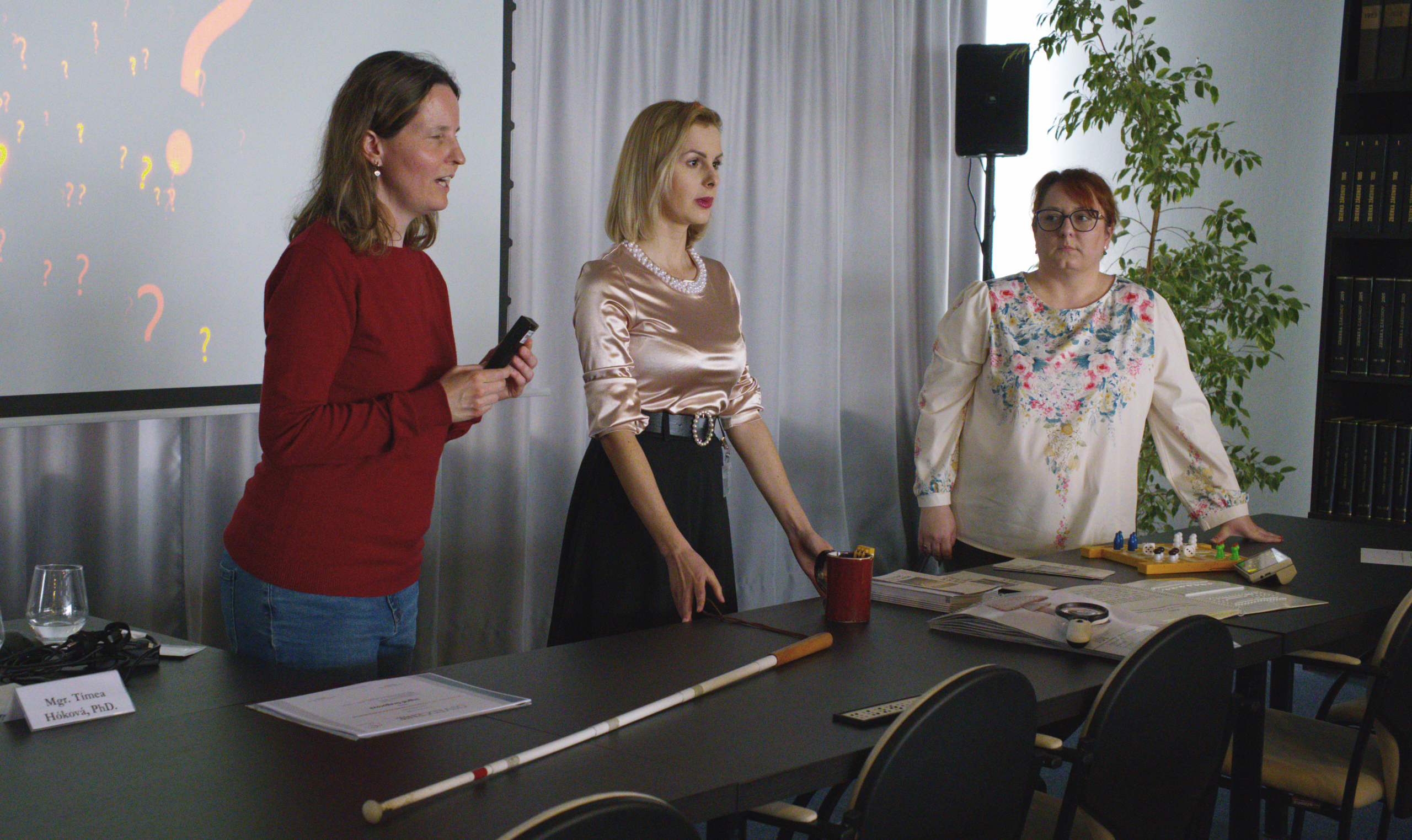
Lecturers of the professional workshop from the UNSS. Photo © The Supreme Administrative Court of the Slovak Republic
The lecturers of the professional workshop were Mgr. Tímea Hóková, PhD., Michaela Serafín, MSc. DiS., and Mgr. Eliška Fričovská, all from the Slovak Blind and Partially Sighted Union (ÚNSS). At the beginning of their presentation, they introduced the organization itself as well as its activities. They continued by addressing the most common myths regarding the blind and partially sighted, explaining, for instance, that not everyone can read Braille. Participants were also informed about different types of visual impairment and learned about the daily lives of visually impaired individuals and the barriers they encounter in their everyday activities. Michaela Serafín further described the mission and operations of the UNSS as follows: “The Union helps people find and implement solutions that allow them to live as independently as possible. In our work, we strive to achieve solutions that are adequate and accessible not only for people with visual impairments but for everyone, because inclusion in practice improves the quality of life for society as a whole.”
The interactive workshop was attended by employees who are most likely to come into contact with visually impaired persons in the course of their duties. Participants had the opportunity to gain comprehensive information on communication and etiquette when interacting with a partially sighted or blind person. Using simulation glasses, they were able to experience various types of visual impairments and diagnoses firsthand. The ÚNSS representatives also brought a variety of compensatory aids (including reading aids) designed to facilitate the lives of visually impaired individuals for demonstration.
The lecturers shared tips and advice with the participants on how to proceed when in contact with a visually impaired person, emphasizing that there is no need to be afraid of approaching them to ask if they would like assistance. If the help is accepted, one of the most important rules to master is verbalization. This means it is necessary to describe in detail exactly what we are doing or are about to do. At the same time, it is important to remember to communicate directly with the impaired person (rather than with their assistant or guide) while facing them. As lecturer Tímea Hóková stated: “Communication is key in any mutual contact, and even more so when it involves a person with a visual impairment. In our case, we emphasize verbalization, which facilitates mutual interaction.”

Demonstration of a board game for persons with visual impairments. Photo © The Supreme Administrative Court of the Slovak Republic
Participants were shown in practice how to proceed when a blind or partially sighted person needs to sign a document, which the participants were able to try out in practice afterwards. It is necessary to summarize or read the content of the document to the visually impaired person before they sign it; alternatively, it is advisable to provide the document in electronic format so they can fully familiarize themselves with it in advance. It is also important to explain where the document is located and guide the blind person to the correct spot, using a signature template if necessary.
During the training, the lecturers specifically focused on the procedure for guiding a visually impaired person through a space, highlighting the necessity of avoiding vague terms. They demonstrated how to offer assistance with movement and cautioned that help should be offered, not imposed. They showcased techniques for guiding a blind or partially sighted person, where the guide remains attentive to both obstacles and the person they are leading. Guidance is offered via the elbow or shoulder; it is always necessary to walk ahead of the blind person while indicating and describing the path ahead. The lecturers emphasized the procedures for navigating tight spaces, passing through doors together, walking up or down stairs, or assisting with seating, and underscored the need to comment on any atypical features in the area. In conclusion, extensive time was provided for questions and discussion, and workshop participants were directed to further detailed information published on the website of the Slovak Blind and Partially Sighted Union – Únia nevidiacich a slabozrakých Slovenska.